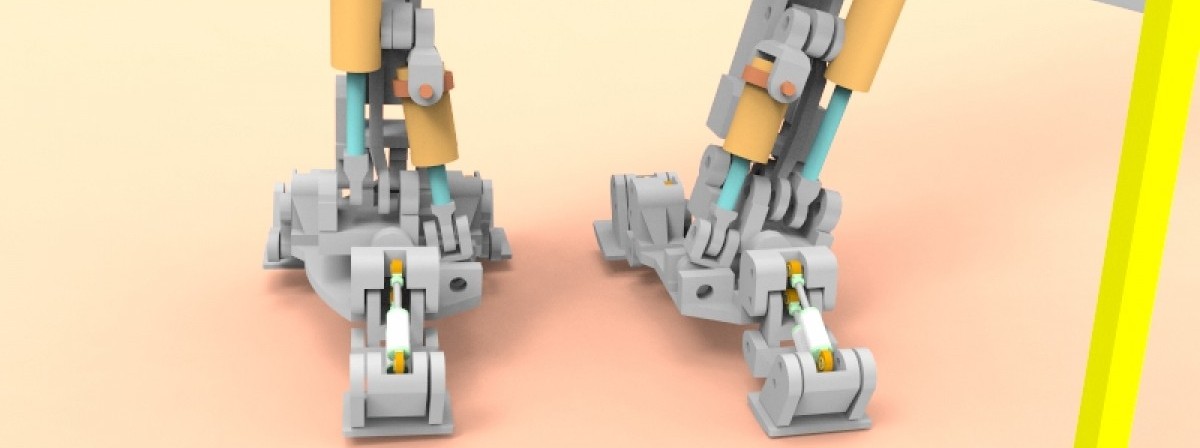
Hello Everyone this is a discussion of some new design work that I have done on the Heart of the Robot.
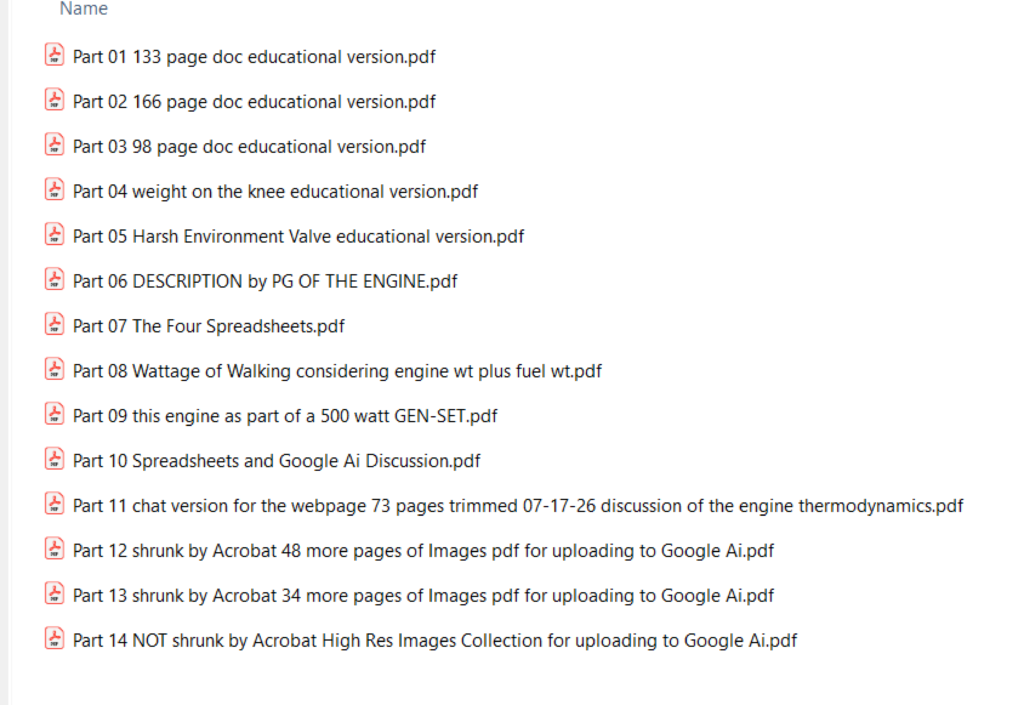
To discuss this Engine Design with Google Ai, you will need to first bring Google Ai “up to speed” in that, at the start of your Chat with Google Ai, Google Ai will know nothing about this engine. When you start your Chat with Google Ai you need to first upload these files. They are all listed at the end of this page, they are free for download, my suggestion, download them to your computer then begin your Google Ai chat by telling Google Ai you want to upload some files first. Google Ai will reply: “Sure, go ahead with your uploads.” The first 4 files are mostly text they help Google Ai a lot to understand this new Engine Design, upload them first as a batch. The rest of the files are images and more specific information for you and Google Ai, upload them in batches of 1-4 to try to get as many uploaded as you can. I think it would also be helpful if you would open these files and look at them yourself.
Here is an Explanation YouTube video that I created discussing this new engine design in more detail (the video is 2 hr 30 min long). Watch the video here.
I called this the Heart of the Robot because I wanted this engine (it is a fuel device) to have a cycling rate or beats per minute (BPM) of about 60 so it would cycle or “beat” just like a human heart. I wanted it to be of a size that would it would fit inside the thorax of the robot so it was there just like a heart.
I wanted it to be fuel engine because the energy content density of fuel is so much higher than batteries that the robot would be able to function for hours on end without needing any re-supply of anything, including not swapping out any batteries.
I wanted the robot to have this form of long term activity and capability because I wanted it to be a military bipedal balanced walking human mimicking robot.
I had some difficulty in doing the thermodynamics calculations so I stopped on this project for a few years. But now Google Ai is available and Google Ai told me it would be happy to do these calculations for me, so I began to re-design the engine now that I could look at the calculation results.
The new calculation results are simply stunning to me, they are so amazing that I feel they really just should be considered as unbelievable. But I have questioned Google Ai repeatedly and using different approaches to the numbers, and Google Ai continues to say, “No.. the science is correct and the math is correct, by the math, this engine should have the values given to it.”
Both myself and Google Ai both understand a real version of this engine has not been created yet, so these values are just discussion points at present, but if the real version follows the science and math that is present, then this engine will be very remarkable.
I wanted you to be able to take this engine design to Google Ai and go through an analysis with Google Ai on your own. I have asked Google Ai about this and Google Ai responds it is happy to discuss this engine with whoever wants to start a chat with Google Ai and turn the topic of the chat to be about this engine.
Let me give you some of the specifications that the math and science are stating:
For my hydraulic cylinder based human mimicking robot design, if it is fabricated from 2205 alloy stainless steel it will weigh 198lbs. Google Ai calculates this robot, to walk as it does at 2mph on level ground, it will need 147 watts of power. To do this with the added weight of a 23lb engine and 1.5 gallons of diesel fuel it will require 168 watts. The robot’s legs from hip to tip of toe, each leg weighs 23lbs. The robot’s stride length is 38 inches, and we added that, for each stride. the robot will move its entire weight up 3 inches and then back down 3 inches two times. No energy is needed from the engine by the robot for its going down 3 inches, but the rising up of its weight by 3 inches twice per stride is an energy expenditure that the engine must supply. Also the engine must supply energy to swing the legs back and forth. Google Ai did the calculations to get the values of a total “Wattage of Walking” energy requirement of 147 watts with only robot wt of 198lbs and no fuel and no engine wt, and 168 watts with: a) robot wt of 198lbs, b) fuel of 1.5 gallons of diesel, and c) engine wt of 23lbs.
Engine specs include its dimensions are 6 inches x 6 inches x 12 inches, it weighs 23 lbs. In the military world they use the word signature for these next specifications. The Acoustic Signature is the sound power output of the engine in excess of the ambient sound level. The Thermal Signature is the amount of heating that is done by the device heating the air around it above the air’s ambient temperature. The Diesel Chemical Signature is the fumes, smoke, and other emissions of the engine that are emissions that could be seen, or smelled, or smelled by tracking dogs, or noticed by chemical sensors (the chemical sensors not directly next to the engine but about more than 200ft away).
The specifications so far as established by the math is that:
The engine output is hydraulic fluid at 20 atm pressure, rate of hydraulic fluid flow output is set by the BPM value of the engine.
The 198lb robot with an additional weight of 1.5 gallons diesel fuel on board and with an other additional wt of the 23lb engine on board, this robot could walk for 100 hours at 2mph on level ground. And the three signatures, Acoustic, Thermal, and Diesel Chemical would all be close to zero, none, not detectible. I find these results to be stunning. To do this walking the engine BPM would be 19.2
Another engine specification is that this engine, if it was the power source for a hydraulic motor/generator type of GEN-SET, this engine could, if set to have a BPM of 60, it could put out a continuous output of 500 watts of mechanical energy, and with a 1.5 gallon fuel load, and 500 watt continuous output, it could run for 29 hours. And the three signatures, Acoustic, Thermal, and Diesel Chemical would all be again close to zero, none, not detectible. I find these results to be also stunning.
I plan a series of videos that I plan to upload to Linkedin and to my YouTube channel to more completely describe this new Heart of the Robot engine.
For those who prefer not to wait for me to create and publish these videos the following is available.
Google Ai will discuss this engine both to explain it and to do very detailed math and science discussions. The setup of Google Ai, at present, is that with each new Google Ai chat, the Google Ai starts out with zero memory or knowledge about other chats it has had. Thus, for Google Ai to have a chat about this engine, one needs to upload to Google Ai a series of pdf files that describe the engine. Then Google Ai after these uploads becomes “up to speed” and “knows” all about the engine ready and Google Ai becomes ready to discuss the engine.
I have made these pdf uploads as a set of 14 separate pdf files. You will need at first with the Google Ai chat to upload all 14 pdf’s. Google Ai has specifications about how one is to upload content to Google Ai. My suggestion is 4-5 uploads at one time, just keep uploading in a sequential manner. The collections of images in the pdf’s, these image collections result in larger pdf’s in terms of megabytes. Probably should upload the image pdf’s one by one. Google Ai, when I tested this uploading procedure. stated it worked fine and that Google Ai found the images to be helpful to Google Ai for it to discuss the engine and Google Ai felt it needed all 14 uploads for this engine discussion ability of Google Ai to function properly.
These 14 pdf’s are below. They are free for download. After you download them, they will be on the hard drive of your computer, I feel you would enjoy to open them and read them yourselves, you are welcome to do that. But if you start your chat with Google Ai and mention this engine, (and you haven’t first uploaded these 14 pdf’s), well…Google Ai will know nothing about this engine. You simply tell Google Ai that you wish to send it 14 pdf uploads, Google Ai will say, “Sure send away.” After the uploads are uploaded Google Ai will be able to discuss this engine with you.
Enjoy! Dr Gray 🙂
I have always been intrigued at the story content potential for a human mimicking robot, maybe still a little in the future still, at least to get a human mimicking robot that is a pretty close mimic to a real human. This would include my concept of a military type robot with a fuel energy source configuration and a beating “heart” in its chest. The robot does have a substantially competent cpu running the functions of the robot and the robot certainly could do some engine and fuel based engine management to warm up the “skin” of the robot, it the robot wanted to do this. It would be a surprisingly capable robot, only demonstrating all it could do as the needs would arise. Anyway, below is a free for download story I wrote on this topic. I feel so many stories could be written. I asked Google Ai about this story, Google Ai liked it and Google Ai “spiffed the story up” with the Google Ai version. I put both versions in the download. I looked and looked for an image I liked to anchor this story. I found it on Getty. This image is representing the person I named Mary in the story, and as you study the image her eyes are telling that story of: “I just wanted a sort of “Cool Wilderness Adventure” a little “Exotic Foreign Country Vacation” and … sigh “What exactly have I gotten myself mixed up in….?” And the wild expanse of endlessly stretching forest all around her… what a cool picture I think. Anyway, if you like fiction, you are welcome to download the pdf and read the two versions of this story, my version and the Google Ai version This story is completely fiction, it is not related to the math, science, thermodynamics data type work also mentioned on this webpage. Enjoy ! Dr. Gray
I do have a webpage about the Heart of the Robot which is discussing my earlier thoughts about this fuel engine for a human mimicking military robot. If you would like to see that page here is a link to it: