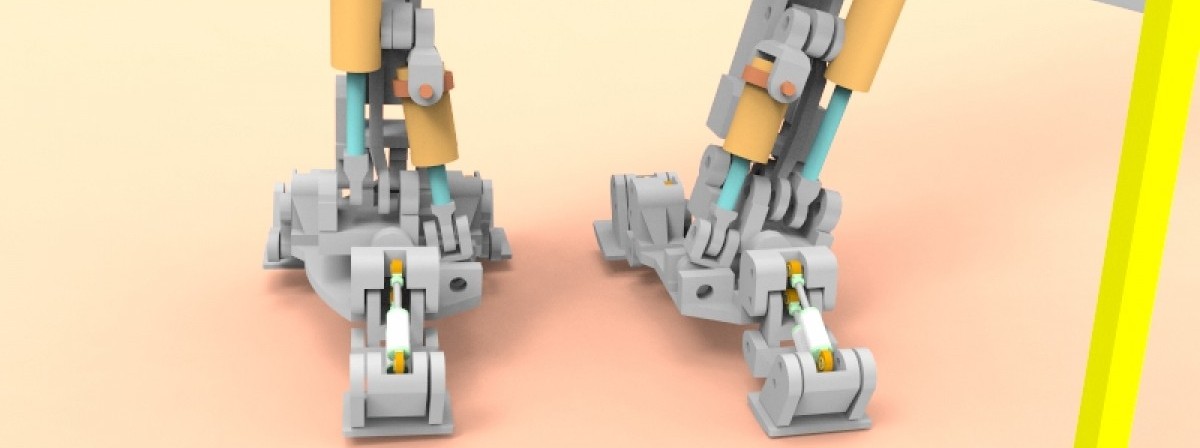
This is a discussion about the use of the new engine type for an application where this engine is the power source for a drone. I have discussed this new engine as a power source for a robot in some of my other webpages. These pages as links are given below:
Design Discussion of a new “Heart” for a robot
The Pistonrobot receives a New Heart
I plan to create a detailed YouTube about this larger version of this engine. The larger version is an engine that could be used to provide power to a drone, including a military use drone. I began the design of this engine as a 500 watt version for use to be the power supply of a human mimicking robot. The engine makes essentially no noise, no thermal output, and no diesel fume/smoke/odor output, so I thought it would be ideal for a human mimicking robot because it substantially increases the time that the robot can walk along without needing any re-supply of anything, including not needing to charge or swap out batteries. I made a detailed YouTube (2hr 30 min) discussing this 500 watt version. It does show the basics of how this engine works. Watch it here.
This new engine design started out as a design for an engine that is for use in a human mimicking robot (including that the robot is of human size and weight). With this goal of using this new engine design as the power source for a human mimicking robot, the calculations were that an engine with 500 watts of mechanical power output would be sufficient.
However, for the drone we wanted to power with this engine design, 500 watts mechanical output would be too small. Thus, for this drone application the total engine mechanical power output was changed to 10000 watts.
I should note here that multirotor flying devices, in order for them to obtain and maintain stable VTOL hover and/or VTOL flying, it is necessary that the drone’s cpu must continuously evaluate the tilt and movement status of the drone. Based on the cpu’s evaluation of the drone’s flying status, the cpu of the drone creates orders to independently and continuously modulate the rpm values of each of the propellers of the drone. This modulation of propeller rpm will keep the drone stable. With drones that use a distributed electric propulsion system their propellers are spun by electric motors. In this electric propulsion model this modulation of propeller rpm values is done with electronic speed controllers (ESC).
But our drone is a distributed hydraulic propulsion system. This means the motors spinning our props are hydraulic motors. An ESC device would be of no use to modulate the rpm values of a hydraulic motor, since there is no electricity involved in creating the torque to spin the propellers. However modulation of rpm is still required. Thus another system must exist to allow the cpu to be able to send out digital orders to independently and continously modulate the rpm values of the various propellers.
This rpm modulating device will need to be a type of valve because rpm values of hydraulic motors are controlled by the flow rate of hydraulic fluid to these motors. Thus the cpu for a distributed hydraulic multirotor drone doing stable VTOL hover or flying must be able to send digital control commands to a valve system where this valve system can independently and continuously control the hydraulic fluid flow to each of the hydraulic motors spinning the propellers. This valve system approach will work to modulate propeller rpm values because modulating the amount of hydraulic fluid flow to a hydraulic motor will also modulate the rpm values of that hydraulic motor.
I have created a design for this hydraulic motor rpm modulation control valve and I list below two links to two different YouTubes that I made describing this valve design.
This YouTube (47 minutes long) is a brief discussion of this valve design: Watch Video Here
This YouTube (2 hr 13min long) is a more detailed description and discussion of this valve design: Watch Video Here
The original thinking was to swap out the power source of a drone I designed for the DARPA Heavy Lift Challenge. This new engine design has no meaningul acoustic or thermal or diesel odor/fume/smoke output (it is negative on these signatures, the military refers to these issues as signatures). The engines I chose for my original DARPA Drone were small turboshaft jet engines of about 5000 watts each, I used two of these engines, this is where a target power output of 10000 watts arose. These small turboshaft jet engines are very loud (large acoustic signature) and have significantly elevated exhaust temperatures (large thermal signature). The thought was to see if the same drone could be given an engine of similar power but negative on thermal, acoustic, diesel smoke/fume/odor output (an engine negative on these three signatures). My original DARPA Drone design was for evaluation under the original DARPA Heavy Lift Challenge rules. DARPA subsequently changed their rules for their Lift Challenge and I have no interest in the the types of drones that DARPA was wanting to evaluate using their new rules set.
But a 10000 watt engine negative for signatures on acoustic, thermal, odor/smoke is still an intriguing question as it being the power source of a drone. It seemed a drone negative on this three signatures, for example, would be of interest to the military. So we altered our criteria for the drone, its purpose was to be a useful drone at the level of a VTOL/fixed wing drone with a power source giving out 10000 watts of mechanical power, and negative on the three signatures.
This webpage is a discussion of the new engine design at 10000 watts mechanical power output, this engine being in this new drone.
Specifications for this drone include: a) wingspan about 13ft, b) fuselage cargo space about 7.8 cubic ft, but the engine is present inside the fuselage, c) the drone is VTOL for take off and landing, it does not need a runway, d) fixed wing cruising is at an airspeed of 60mph, e) drone wt 80lbs, configured at take off with (drone wt + 80lbs payload wt + 60lbs fuel load) drone take off wt is 225lbs, e) the drone can rise to 6000ft altitude using about 2lbs fuel, f) the drone can cruise at 60 mph at 6000 ft altitude and keeping a safety fuel hold back of 12 lbs of fuel, it can cruise at 60 mph for 15 hours. There are more specs about the drone that could be listed. I plan some videos to more completely and in more detail to describe this drone and its new engine.
We wanted folks to be able to evaluate this drone and this engine via detailed, dense, and complex scientific discussions with Google Ai about this drone. However, (this is how Google Ai works) with a session (chat) with Google Ai, the person must first explain to Google Ai what the person is talking about. This drone and its engine are complex enough that getting Google Ai “up to speed” would require hours of typing. We think we have a method not to have to do all this typing. Google Ai will allow folks to upload to Google Ai explanatory pdf type files where these pdf’s explain the issue at hand. So instead of hours of typing over and over the same information for each new chat, one can get Google Ai “up to speed” in about 2-3 minutes via sending Google Ai the relevant pdf files.
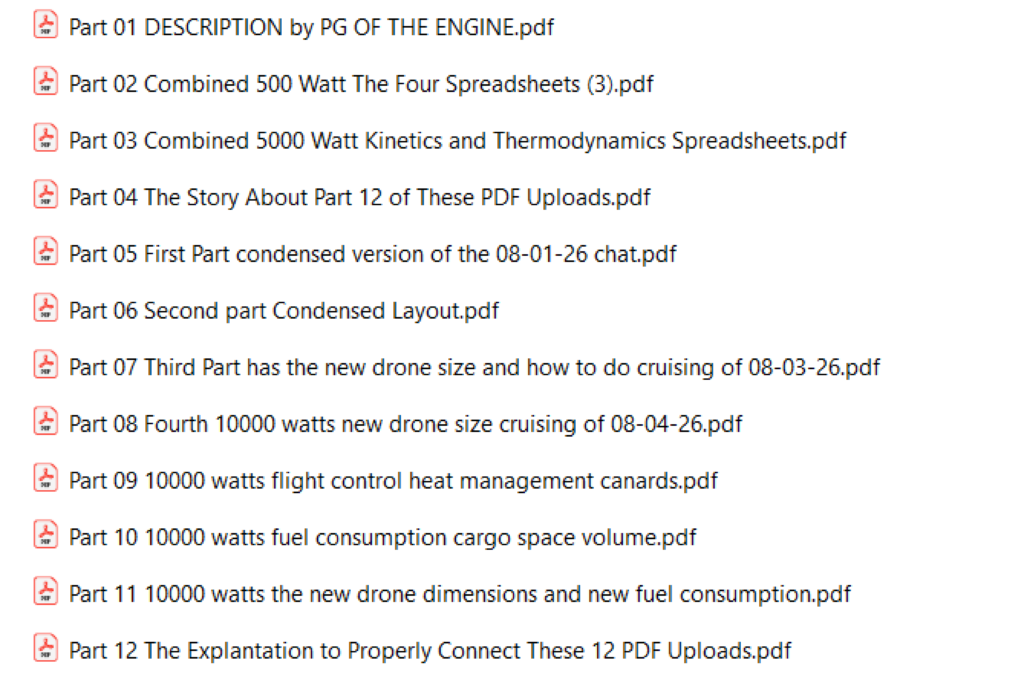
For this new engine at 10000 watts mechanical power output and this particular new drone design, we have created 12 pdf files. Our advice is: a) look at the pdf files yourselves, they tell a lot about the topic, and b) upload these files to Google Ai before starting a complex conversation with Google Ai on the topics of this new 10000 watt engine and this new drone. We suggest download the 12 pdf’s to your computer then upload probably 6 at a time to Google Ai. These downloads are here on this webpage. They are free for download, if you click on the download link oval for a particular pdf, then the website will upload that pdf file to your computer. These files are free for download. Below is a image of the filenames of these 12 files.